Governance and leadership
A nonprofit board governs the organization at a high level. It oversees mission, financial stewardship and executive accountability without managing every cue or daily task. The nonprofit organization overview explains the broad form; specific duties depend on governing documents and law.
Executive leadership turns strategy into operations. Artistic leadership shapes programming and creative relationships. In some theatres those responsibilities sit with separate roles; in others they overlap. Clear boundaries help staff understand who decides artistic questions, employment matters, budgets and building use.
Production management
Production staff connect creative plans with the building, calendar and resources. They review technical requirements, schedule crews, coordinate equipment and track the many dependencies between departments. A scenic change can affect lighting positions, sound paths, labor and rehearsal time.
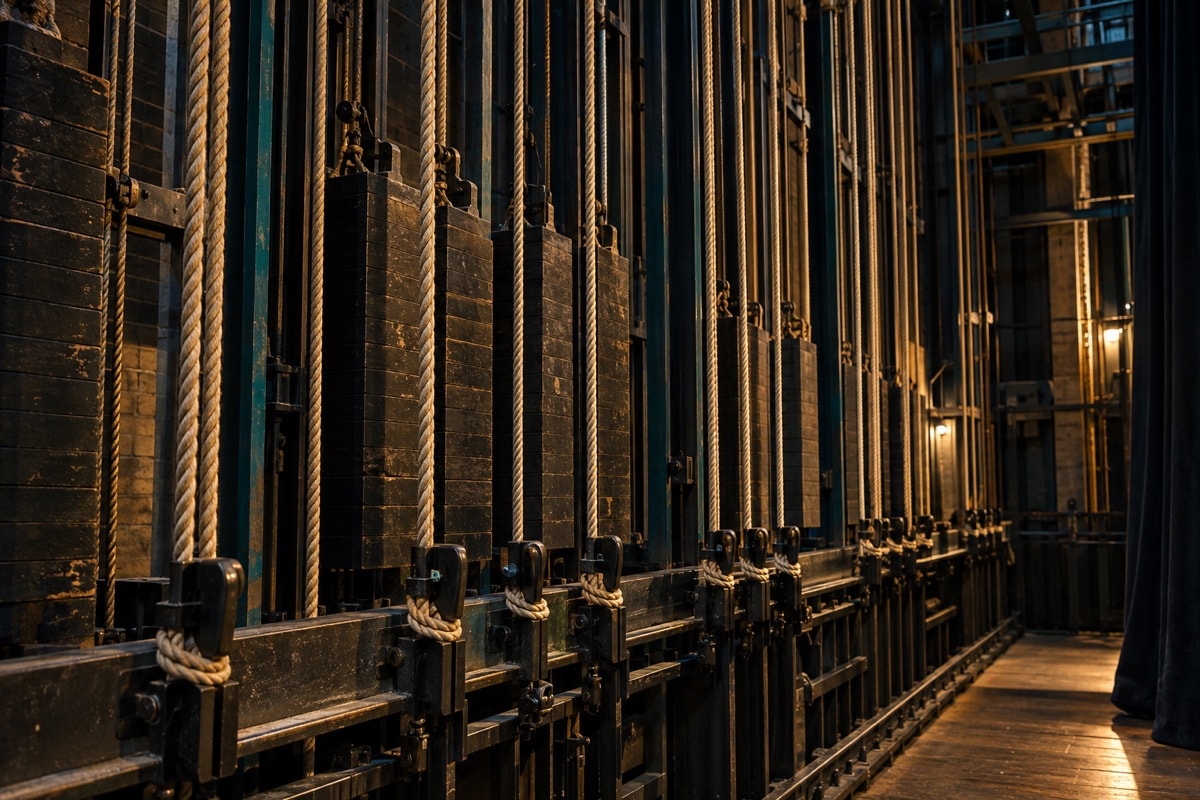
Technical leadership understands the room as a system. That knowledge includes stage machinery, electrical distribution, loading, safety practice and the condition of equipment. Visiting productions bring their own plan, but the house team determines how it can be carried out in the venue.
Stage management and the show call
Stage management coordinates information and helps organize rehearsals and performances. The stage manager tracks blocking, communicates changes, prepares reports and calls cues so that lighting, sound, scenery and performers move through the same sequence.
Calling a show requires attention to both the score of cues and the live event. A delayed entrance or longer audience response may affect timing. The stage manager maintains the structure while communicating with people who can see only their own part of the system.
Stagehands and department craft
Stagehands work in areas such as scenery, rigging, lighting, sound, properties and wardrobe. Many entertainment technicians are represented by IATSE. Collective agreements can define job assignments, calls and working conditions.
The labor is both skilled and collaborative. A load-in turns packed equipment into a functioning production under time pressure. A changeover reverses the process and prepares the room for what comes next. Safe speed comes from planning and practiced communication, not from bypassing procedure.
Front of house
The front of house covers the audience-facing operation and spaces. A house manager coordinates public opening, ushers, seating issues and communication with stage management. Admission staff handle current sales and collection systems on behalf of the venue or presenter.
Ushers help people navigate, protect clear aisles and respond to immediate audience needs. They also observe the room. A spill, illness or blocked exit can become important quickly in low light. The role combines hospitality with safety.
Volunteers and boundaries
Some theatres use volunteers for ushering or community activity. A useful volunteer role has training, supervision and a defined scope. Goodwill cannot substitute for authority around technical equipment, confidential information or emergency decisions.
This guide has no volunteer programme and offers no placement route. Someone interested in theatre work can study job descriptions, local training and the different rhythms of administration, production and public service before approaching a current organization through its official channel.
A career made of handoffs
Theatre management rewards people who can pass accurate information across departments. A contract becomes a schedule; a schedule becomes a call; a design becomes equipment and labor; a public listing becomes an audience entering at a particular time.
No single role controls the entire evening. The performance happens because governance, planning, craft and public care meet at the right moments. That network is the theatre's less visible ensemble.
The handoff before doors open
Before the public enters, stage management confirms readiness with production departments and front of house. The house manager needs to know when the auditorium can open; admission staff need accurate seating holds; ushers need any route changes; crew members need a clear stage. This handoff prevents separate teams from making incompatible assumptions. During the event, communication continues without pulling audience attention away from the performance. Afterward, reports record incidents, equipment issues and schedule changes so that the next call begins with shared facts rather than memory. Reliable handoffs protect the audience experience and the people doing the work.